Long Island Landscape Lighting for Beauty Safety and Free Demos
A beautiful home can disappear after sunset. The walkway gets harder to see, the front steps blend into the dark, and the best parts of the yard fade into the background. The right lighting changes that in one evening.
Landscape lighting gives a home warmth, depth, and a safer path for family and guests. Across Nassau and Suffolk County, from Huntington and Melville to Garden City, Muttontown, Woodbury, Massapequa, and nearby towns, homeowners use lighting to make their property feel more welcoming without making it look overdone.
Even better, the process does not have to be a guessing game. With free renderings and lighting demos, you can see the look before you buy. A 10-light system starts at $2,499, which makes it easier to plan a first phase with confidence.

Good lighting makes a home feel complete after dark
The best landscape lighting does not shout for attention. It guides the eye.
A few well-placed fixtures can highlight stonework, frame the front entrance, brighten a walkway, or bring out the shape of mature trees. In neighborhoods with established homes, larger lots, and layered landscaping, lighting can make the property feel balanced from the curb.
This is where design matters. More lights do not always mean a better result. A thoughtful plan focuses on:
The front walkway and steps
The driveway approach
Trees, shrubs, and garden beds
Architectural features like columns, peaks, stone, and brick
Patios, pool areas, and outdoor living spaces
Dark corners that make the yard feel unfinished
The goal is a soft, natural glow. Good lighting should feel inviting, not harsh. It should make the home look cared for while keeping the night sky and neighboring homes in mind.
For many homes, the front of the property is the best place to start. A smaller system can make a clear difference, then more zones can be added later around patios, pools, side yards, or backyard entertaining areas.
Safety is one of the biggest benefits
Beauty gets most of the attention, but safety is just as important. Entry paths, steps, retaining walls, uneven walkways, and driveway edges all become harder to judge at night.
Outdoor lighting helps people move around the property with more confidence. Guests can see where to walk. Delivery drivers can find the front door. Family members coming home late can get from the driveway to the house without feeling like they are stepping into darkness.
For homes in areas like Woodbury, Muttontown, and Melville, where longer driveways and larger yards are common, lighting can help define the route to the entrance. In places like Garden City, Huntington, and Massapequa, it can make front paths, porches, and shared outdoor spaces feel warmer and easier to use.
A safer lighting plan often includes:
Path lights along walkways
Step lights near elevation changes
Soft uplighting near the front entry
Accent lighting near driveway edges
Lighting around patios, decks, and sitting areas
The key is placement. Fixtures should reduce dark spots without creating glare. If a light shines straight into someone’s eyes, it is not doing its job well.

Free renderings help you picture the finished look
Many homeowners know they want lighting, but they are not sure where the lights should go or how the final result will look. That is normal.
A free rendering makes the design easier to understand. Instead of trying to imagine the effect from a fixture list, you can see a visual concept of the property with lighting in place. It helps answer practical questions before installation begins.
Will the tree lighting be too bright? Should the front columns be lit? Does the walkway need lights on both sides? Would the home look better with warm accent lighting near the entry?
A rendering makes those conversations much easier. It also helps plan the project in phases. If the full property does not need to be completed at once, the first phase can focus on the most visible and useful areas.
For anyone searching for Landscape lighting long island Ny, this design-first approach is a smart way to compare options. A good installer should be able to explain why each light belongs where it is placed.
Lighting demos let you see it before buying
Renderings are helpful, but a live demo can be even more reassuring. A lighting demo lets you see real fixtures and real light on your home before making a final decision.
That matters because every property is different. Brick, stone, siding, trees, and plantings all react to light in their own way. A fixture that looks perfect on one home may need a different angle or brightness on another.
During a demo, lights can be tested around key areas such as the front entrance, walkway, trees, or architectural details. This gives you a better sense of:
Light color and warmth
Beam width and brightness
Fixture placement
Shadows and contrast
How the home looks from the street
It is a simple idea, but it removes a lot of uncertainty. You do not have to hope the design will look right. You can see the effect in person first.
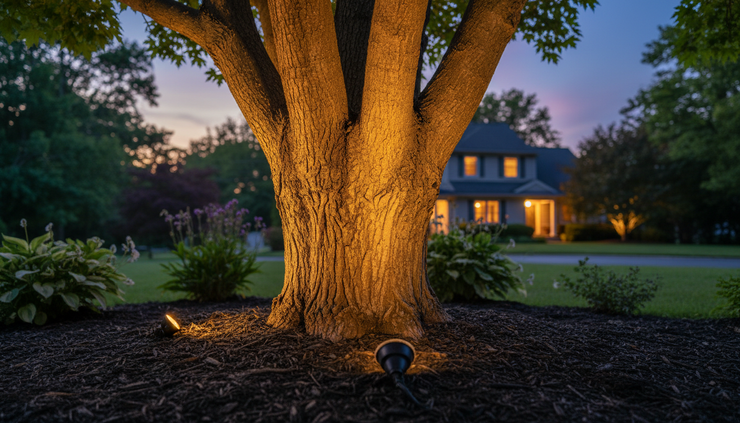
A 10-light system is a strong place to start
A starting price of $2,499 for a 10-light system gives homeowners a clear entry point. Ten lights can often cover the most important areas of the front of a home, depending on the layout.
A typical starter design might include path lights along the walkway, accent lights for the front entry, and uplights for one or two trees or architectural features. The exact plan should depend on the property, not a one-size-fits-all package.
Here is a simple way to think about a starter system:
Focus area | What the lights can do |
Walkway | Help guide people safely to the entry |
Front door | Create a warm welcome and better visibility |
Trees | Add height, texture, and curb appeal |
Home exterior | Highlight stone, brick, columns, or rooflines |
Driveway edge | Make arrival easier after dark |
A first phase does not have to do everything. It should make the biggest impact in the places seen and used most often.
Later, more lighting can be added around the backyard, patio, pool, outdoor kitchen, garden beds, or side paths. A well-planned system should leave room to grow.
Long Island homes need lighting that fits the property
Homes across Nassau and Suffolk County vary a lot. A colonial in Garden City may call for a classic, balanced lighting plan. A wooded Muttontown property may need subtle tree lighting and a clear path to the front entrance. A home near Huntington Village might focus on curb appeal and outdoor dining. A Massapequa backyard may need comfortable lighting around a patio or pool area.
That local variety is why design, demos, and good fixture placement matter. The lighting should fit the home, the landscaping, and the way the property is used.

The right lighting should make a home feel safer, warmer, and more enjoyable after sunset. Start with the areas that matter most, ask to see a rendering, try a demo if available, and build a system that fits the property instead of copying someone else’s yard. For Long Island homeowners, that is the simplest path to lighting that looks good on day one and keeps working beautifully every night.


Comments